Dolça, with a 'broken c'
Hello! My name is Dolça, and this is the first post of my new blog. After giving it some though, I believe it would be nice to give a proper introduction to my name, which I love despite all the administrative headaches it has brought me through all my life.
Meaning
In terms of origin and meaning, Dolça is a Catalan name that means sweet. In Catalan it would work as an adjective used to define feminine words that are sweet, like 'aigua dolça' (lit. sweet water, meaning freshwater in Catalan) or 'flauta dolça' (lit. sweet flute, which is how we call a recorder in Catalan). According to the INE (Instituto Nacional de Estadística from Spain) there's barely more than 100 people with this name at the moment, so it is pretty rare :)
Ortography
Dolça is written with a broken c (or 'ce trencada' in Catalan), which is this fancy c with a cute little symbol at its lower point. This letter, also known as c with cedilla, is present in multiple languages including Catalan, French, Portuguese, Albanian and Turkish.
Unfortunately, writing this character is not straightforward in many situations. The ç cannot be represented with ASCII and many keyboards don't have a key to easily type it. On mobile it has gotten better because you can just long press the c to get a c with cedilla. But on PC, when the key is not there, a bit of copy-pasting, using Unicode (U+00E7) or tweaking around the language/keyboard settings is required to get to it.
Speaking of writing, setting up my websites made me discover the magic of Punycode and how my domain dolça.cat sometimes becomes (or 'needs' to become) xn--dola-2oa.cat under some mysterious black magic spell. On the URL bar from the browser, you can see how I managed to make my URL redirect from dolca.cat to dolça.cat, and most browsers properly display the ç. But in places like Bluesky, when I write dolça.cat the punycode transformation happens automatically and you see xn--dola-2oa.cat instead. Since looking at that link it seems you are going to get teleported to some encrypted sci-fi universe, I decided (unfortunately) to write dolca.cat over there to avoid misunderstanding.
'Bluesky, if you are listening, please it would be amazing if you can make URLs with special characters like dolça.cat visually stay as they are without taking the punycode form!' - Dolça
Seeing all these problematiques, and how I even have to bend myself and type Dolca instead of Dolça sometimes (even though it breaks my heart), I understand when someone cannot write my name correctly due to technical difficulties. However, it always makes me extra happy to find people who care and try to write it correctly even when it takes them a couple more seconds.
Pronunciation
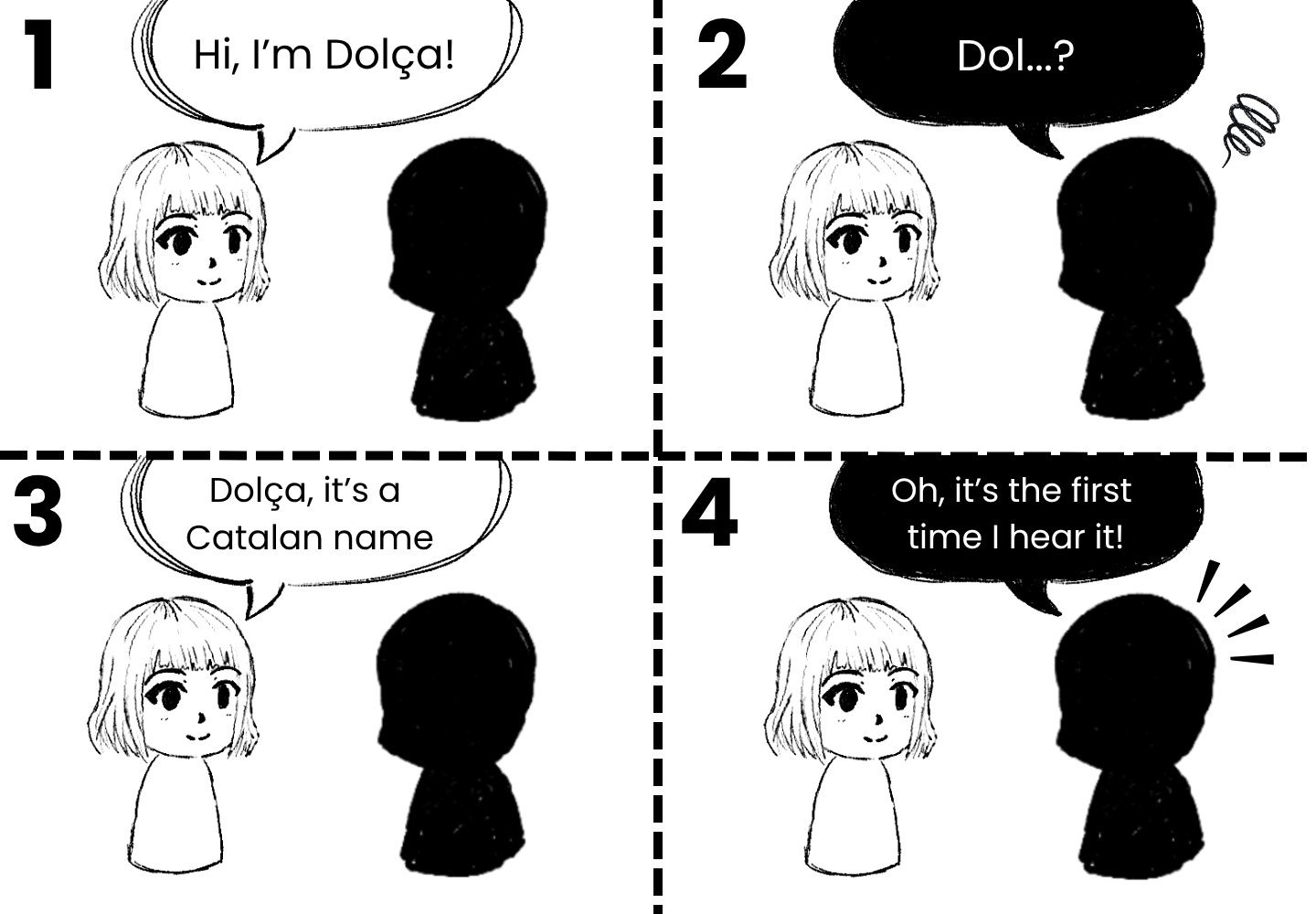
And last but not least, the pronunciation of my name. Here it's when fun things happen and I get all kinds of surprises. The 'official' pronunciation of my name in IPA (International Phonetic Alphabet) is /ˈdɔɫ.sa/. This means the ç sounds 'like a soft s', 'a bit like the ß in German', 'like さ in Japanese', 'not like the ç sound in Albanian/Turkish but like the ç sound in French/Portuguese' and so on. You can imagine the amount of times I had this conversation during my lifetime. But it's always interesting to me to see how depending on the native language of each person sometimes they have more or less difficulties to pronounce my name or they tend to 'guess' it's pronunciation one way or another.
---
That's it for now, thanks for reading!
Dolça